Showing posts with label polymer clay. Show all posts

Friday, September 27, 2013

What's On My Workbench


I've been working with new colors, combinations and patterns in my studio for fall. Red, black, and white continues to be very popular. I love working with the graphic contrast.

The contrast and lines in the canes remind me of comic book art, or perhaps some kind of alphabet or symbolism.

The complex, winding lines and shapes seem to speak of new languages, mystical communications.

Besides working in my studio and playing with new colors and patterns for fall, you can find me at SevenArts Gallery in Ellsworth, Maine some days of the week-- just contact me for my schedule in the gallery. My work is always available there, Monday through Saturday, 10 am to 5 pm.

Tuesday, July 9, 2013

A Women's History of Polymer Clay: How Women Developed, Marketed, and Expanded the Possibilities of an Art Form

Sophie "Fifi" Rehbinder-Kruse, developer of polymer clay
One of the coolest things about working in a field like jewelry making-- in particular polymer clay jewelry making-- is that there is such a long and interesting history of women working in the craft.

Women's work in the arts has often been focused on making handcrafts, and often in creating artisan goods that will be used and enjoyed in everyday life. The creation of jewelry and pottery and clothing have been fields where women have long shown incredible artistic strength. Historically, these artisan goods have not been prized as "art,"  but rather dismissed as "mere" craft.The amazing talents that women have displayed in both traditional and new handcrafts has not been fully recognized.

Thankfully in modern times this distinction between fine art and "mere craft" is being challenged. The incredible talents of people--often women-- working in craft is being recognized as truly masterful work.

For polymer clay artists, there is an additional connection to women's history through the medium itself. Prior to the 1930s, there was no clay that worked as well as polymer clay does today for the home or professional modeller. Bakelite was often used for modelling, but it turned out to be flammable (yikes!) and was discontinued.

Traditional doll painting by hand. (source)
A better kind of modeling clay was sorely needed. In place of Bakelite came a variety of polymer blends-- of varying quality. German dollmaker Kaethe Kruse came across one of these polymer clay formulations, which she hoped to develop for use in her factory. However, it didn't work.

Kaethe passed it on to her daughter, Sophie Rehbinder-Kruse, better known as Fifi. Fifi was also a dollmaker. Shortages in Germany were very common at that time (It was the 1930's, remember) and Fifi had been struggling to find a material for modelling her doll's heads.


Fifi tweaked the formulation of the new polyclay until she found the perfect blend. This new clay could be used to model almost anything, and could be baked in a regular oven. It was the ideal compound for making virtually any kind of small object in a home workshop. She dubbed her blend "FIMOIK"  or "Fifi Mosaic" and sold it under this name in Europe. She even introduced a polymer clay modeling kit onto the market.

So successful was she, that in 1964, German office and art supply company Eberhard Faber (which later become Staedtler, and today is known as PaperMate) acquired the rights from Fifi for her polymer clay. After tweaking the recipe, the new product was introduced on a mass scale, marketed as a modelling compound for children's art projects. It was named FIMO, short for Fifi Mosaic. The name, of course, is the one known to polymer clay artists worldwide today.

Pier Voulkos, pioneering polymer
clay jewelry artist
Though FIMO was marketed mostly to children and home hobbyists, it didn't take long for artists to catch on to the potential of the medium. Soon, artists and craftspeople in the US and Europe began to explore the "new clay."

Probably the first artist to make beads and jewelry from polymer clay was Pier Voulkos, who began creating beads in 1978. According to Ornament magazine, Voulkos "explored many of the qualities polymer would build its reputation on—vibrant and whimsical use of color, both in patternmaking and joining multiple shades, sculptural and handformed techniques, the repetition of geometric designs, exploration of traditional and nontraditional bead shapes." Voulkos sold polymer clay jewelry work in several galleries at a time when FIMO was still being sold mostly in children's stores as a toy. Her talent woke other artists up to the possibilities of polymer clay.

The first major book covering
polymer clay in a comprehensive
way, highlighting the growing
interest in the medium


Over the years, various artists have expanded the sense of what is possible with polymer clay. Kathleen Dustin began to explore techniques beginning in the 70s, borrowing millefiore caning from glasswork and neriage from thrown pottery.

Toward the end of the 80s, Tory Hughes
took  polymer clay a step further with conceptual pieces that evoked an inner narrative. Hughes commented on polymer clay's versatility, saying, "“I’m really interested by the fact that my jewelry has had the acceptance it has in the fine craft world, because Fimo can be such a mundane medium … It intrigues me that I have somehow managed to transcend it by the things that I do and the philosophical approach I bring to my work.”

The growing interest in polymer clay was reflected in the introduction of the first comprehensive book on the subject, The New Clay: Techniques and Approaches to Jewelry Making. The book, penned by Nan Roche, covered the history of the clay as well as modern techniques. The clay that had started out as a good material for making doll heads in a scarce wartime economy had become a fascinating and exciting medium for art.

The history of women and craft has always been about ingenuity and resourcefulness. Turning whatever is available into a beautiful, useful item-- whether it's scraps of old clothing into a quilt or a kid's modelling compound into jewelry that can be shown in fine New York galleries-- women have always been on the cutting edge of fine craft. That sense of possibility-- looking at a "mundane medium" and seeing possibilities of color, form, and function arise in the mind-- is what has always driven the development of polymer clay, and the women who have advanced it throughout history.


Thursday, July 4, 2013

Elegance: Black Cuff Bracelets and Bangles

YIKES! Studio: Black bangles and black starfish cuff

Black is the color of elegance, considered to never go out of style, to go with everything. Fashion designers have always had a great deal to say about black. Italian designer Gianni Versace said, "Black is the quintessence of simplicity and elegance." Dior defined black as the essence of elegance, a quality which he said was a "combination of distinction, naturalness, care and simplicity."

Black has enjoyed multiple periods of being in style throughout history. Black was the favored color of nobility throughout the 14th through 16th centuries in Europe, with the trend beginning in Italy and spreading across countries to all the monarchs of Europe. Black fabric was long considered special because a truly deep black required the very best dyes.

Black may also have become popular because wealthy merchants favored it. After laws prohibited these merchants from wearing certain flashy and expensive clothes in bright colors because they were not royalty, the upper classes took to wearing black. Ironically, this may have served to popularize the color black as a color associated with the upper class-- and royalty. By the 16th century, black was what all the monarchs were wearing!

In 1926, Coco Chanel popularized the ubiquitous little black dress as the fashion article that all women needed, saying "A woman needs just three things; a black dress, a black sweater, and, on her arm, a man she loves." French designer Yves Saint Laurent said, "Black is the liaison which connects art and fashion."

Do you love black? Is it a fashion staple for you or does it only make an occasional appearance? Black accessories can be elegant, striking additions your wardobe. A black dress and matching bangles with a touch of sparkle can be the perfect, timeless combination for a wonderful night out on the town.

I will be at the Maine Crafts Guild Damariscotta Show this weekend,  Saturday, July 6, 2013 from 10 am to 5 pm  and Sunday, July 7, 2013 from 10 am to 4 pm, with my newest studded starfish cuffs and bangles in black. I hope you'll consider adding one to your collection.

Karl Lagerfeld, explaining why black was so popular, said: "Black is the color that goes with everything. If you're wearing black, you're on sure ground." Timeless and elegant, striking and simple, it's easy to see why black has been so popular and continues to be today.


Tuesday, June 11, 2013

Pushing the Limits of Polymer: Cool, Weird Clay Creations

Polymer clay is an astonishingly limitless medium. It can be used to create the tiniest of picture-perfect objects. Miniature pies, with each berry glinting in the light, can be fashioned by expert artisans. Detailed animal figurines, looking just like the real thing, can emerge from blocks of polymer clay. Fine artists and playful worshippers of various television shows and comic genres can equally exploit the qualities of polymer clay to create objects to suit their fancy.

Here we check out a few unusual polymer clay creations. They might not be something you'd like to own personally, but then again, inspiration comes in all forms. These creations show off the possibilities of polymer clay.


Here's a mindblowing piece of artistry: A complex, twining set of octopus tentacle jewelry by Kaity O'Shea aka KTOctopus. Can you imagine wearing this? If so, what with? Something tells me that no matter what you wear with it, this jewelry's going to take center stage.


These Animal Cling Rings are by Japanese artist Jiro Miura, working under brand name Count Blue. Miura creates these exquisitely detailed animal rings as well as figurines; his designs have also been used to create mass produced phone plugs and rings. It's a lucky artist who sees his work become so popular.


Baby seal rings by Jiro Miura
An attention-getting ring for sure.


Low cost and ease of use make polymer clay an ideal choice for unorthodox one-of-a-kind creations. Above is My Little Batman and Robin by Jodi Moisan. Moisan's precision with these handcrafted My Little Pony-based superhero figurines is astonishing.The exact reasoning behind creating My Little Ponies dressed as various characters from comics and movies isn't quite clear, but they're nothing short of adorable.


Joe Fig is a man of many mediums, but this diorama comes from his series of table sculptures of artists' studios in their full splendor and disarray. This particular table sculpture shows the studio of April Gornik. These studio dioramas were gathered together into a book, Inside the Artist's Studio, which is introduced this way:
"Inside an art gallery, it is easy to forget that the paintings there are the end products of a process involving not only creative inspiration, but also plenty of physical and logistical details. It is these "cruder," more mundane aspects of a painter's daily routine that motivated Brooklyn artist Joe Fig to embark almost ten years ago on a highly unorthodox, multilayered exploration of the working life of the professional artist. Determined to ground his research in the physical world, Fig began constructing a series of diorama-like miniature reproductions of the studios of modern art's most legendary painters..."
Fig uses many materials to construct his unusual tributes to the artistic process, including polymer clay.


Another by Joe Fig, this one depicting the studio of Dana Schutz.


With its blendable, vibrant colors and translucent options, polymer clay works well for skin, even the delicate  rosy skin of weirdly tiny babies. Adorable? A little creepy? The talented Camille Adams creates these tiny polymer clay babies.


Some polymer clay artists test their skill-- and even make a living-- creating tiny lifelike foods in 1:12, 1:24, even 1:48 scale. The miniature polymer foods are purchased by collectors for well-appointed dollhouses. This fish spread was made by Stephanie Kilgast.


Last but not least, Afsaneh Tajvidi steals our hearts away with her beautiful polymer clay snails. 


Tuesday, May 7, 2013

How to Make Big Beads from Polymer Clay

I love to make necklaces with big beads. Larger beads and pendants are a great way to combine a variety of techniques and play with color and texture. Big beads can be attention-grabbing, beautiful and bold. They're in style right now and many people are interested in creating them for their own pieces.

Here I'll show you how I make my big beads from start to finish.

In making larger polymer clay beads, two issues that come up are dealing with the heavier weight (for the largest beads) and not wanting to use up valuable clay for the inside of the bead, which no one will see anyway. There are simple solutions for these problems.


1. Create a "Dummy Bead" Inside the Bead


For medium size beads, I roll junk clay into balls. I keep a plastic bag of "junk clay" bits and pieces from other projects for this purpose. The recycled junk clay makes up most of the bulk of the large bead.

For really large beads, I use a crumpled tin foil core. The foil cure helps to ensure even, proper curing in the oven and cuts down on the weight. If you choose to use foil, the foil ball should be nice and tightly compacted.


2. Cover the Junk Clay or Foil With the Desired Colors


Cover the junk clay bead with the desired color of clay. To get a nice, smooth covering on the bead, roll out your desired colors into thin sheets which you can tear pieces from.

Watch that no air bubbles are left in the clay. If you do see them, slit into the bubble with your tissue blade and smooth to remove. Round off your beads in your palms to smooth.


3. Add Canes and Coverings to the Bead


Make up your canes and coverings to apply to your beads. Here I have made a mokume-gane to use in some of the beads. (Try a tutorial for polymer clay mokume-game here or here.)

Layers of caning and patterns have been applied
and smoothed...
Not bad, but I feel they are lacking a bit of something.


Now I am satisfied!


4. Pierce, Cure and Sand

I carefully cure these in a calibrated oven for one hour.  The beads above have been pierced and cured and are ready for sanding.

Making big beads is a wonderful way to experiment with various techniques and color combinations. Enjoy creating! ❉

Thursday, April 18, 2013

Good Enough to Eat! Delectable Miniature Polymer Clay Food

Spring is the time when seedlings are poking their heads above the soil and unfurling their first tender green branches. Here in Maine, the early Spring tends to, well, drag on for a while. The grass seems to refuse to get greener, preferring to maintain a grayish-brown hue.

Still, we start longing for fresh, colorful spring vegetables, tender garden tomatoes and hand-chopped basil leaves, colorful rainbow Swiss chard and the drifting smoky smell of a barbeque.

To satisfy your craving for delicious foods, here is a selection of delicious inedibles-- incredible polymer clay "miniature food" arrangements that will make your mouth water and get your creative juices flowing. Just the thing for Spring!


Dinner prep, in the palm of your hand -- by  Shay Aaron, Israel


An assortment of wild mushrooms - Linda Cummings


A spread of barbeque tastiness by  Shay Aaron


A dinner for two by Shay Aaron


Peach pie by After Dark Miniatures


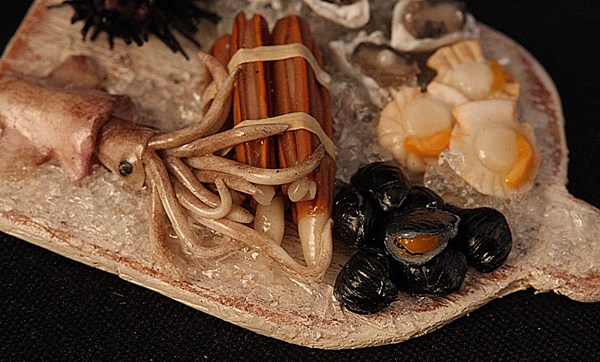
Seafood by Linda Cummings


Garlic and peppers by Janet at Minnie Kitchen


Miniature polymer food has even found its way to avante-garde makeup, through the work of Eva Senín Pernas, who creates intricate lip art with fresh slices of polymer fruit:


Fruity lips by  Eva Senín Pernas


Friday, March 29, 2013

What's On My Bench (WOMB) This Week: Sanding and Finishing Polymer Earrings!

My workbench is where my polymer pieces are "born"- it's kind of like a womb for polymer earrings, cuffs and necklaces! Each polymer clay piece I create is carefully crafted, formed and then cured, but that's only part of the process. To create beautiful and professional polymer jewelry, the secret is in the finishing.


Today I'll take you through the steps for finishing polymer earrings, with photos from my studio.


My Four-Step Process for Finishing Polymer Clay Earrings...

  1. Sanding the pieces and buffing
  2. Creating the ear wires and attaching
  3. Selecting Swarovski crystal embellishment for each pair
  4. Assembling the earrings-- bringing all the pieces and details together!


It all starts with sanding...and more sanding...and more sanding. I work from 800 grit through 2500 grit wet/dry sandpaper in soapy water. The sudsy water helps to keep the sandpaper free of debris.

My hands get really sore from this but they are super clean-- and my pieces look great! If you have trouble with sore fingers from sanding, try wrapping your fingers with masking tape.


When I am satisfied that my pieces are sanded to perfection, it's time to begin assembling the earrings into their final form. Every set of earrings gets their own pair of unique, hand-formed sterling silver ear wires. I use 20 gauge half-hard round wire.


Here is a peek at a brand new shape I'm working on now for YIKES!Studio. The ear wires on these earrings have a hook on back. The shape and colors of this piece are organic and perfect for spring. I've chosen a light blue Swarovski dangle for the ear wire.


These red and black earrings needed a little extra on the ear wires. I wrapped blackened steel wire around the sterling silver. I love the way the black steel mimics the lines in the polymer.


Manipulating the steel wire around the ear wire.


Here I want to create a funky, messy looking knot of wire to attach the ear wire to. It starts with a loop from the blackened steel wire.


More wire bending


Finished wire work. I like a messy looking knot of wire. Its just more fun that way!


Finished!


I have been working on some photos for my new, soon-to-launch website! Stay tuned!

Monday, July 18, 2011

Ornament Magazine does article on polymer clay history

Ornament Magazine has done a really nice article in the July issue on the history and pioneers in polymer clay jewelry. It's really nice to see this as we polymer artists still struggle with the perception that polymer is not a "real" medium and not always taken seriously. With polymer, like other mediums, it is what happens in really skilled and creative hands that determines the worth of the piece-- not the medium itself.


The story, Polymer Clay, A Modern Medium Comes of Age  is nicely illustrated with a timeline and images from the polymer heavyweights such as Kathleen Dunstin, Ford and Forlano.